Alan Turing
1912–1954 • Lived to 42
United Kingdom
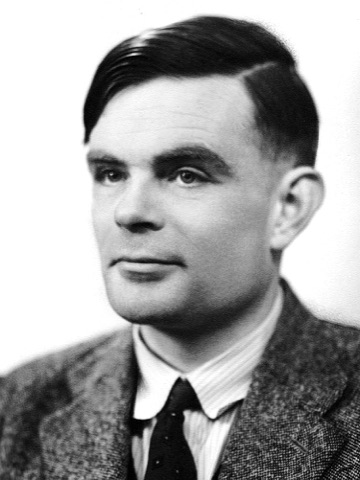
About
Alan Turing was a British mathematician and logician, born in London in 1912, who laid the theoretical foundations of computer science before the discipline existed. In his 1936 paper "On Computable Numbers", he introduced the abstract computing model now known as the Turing machine. Built from nothing more than a tape and a read/write head, this simple device gave a mathematical definition of what it means to be "computable" and became the theoretical blueprint for every modern computer.
During the Second World War, Turing led the effort to break the German Enigma cipher at Bletchley Park. The electromechanical codebreaking machine he helped design, the Bombe, systematically searched Enigma's daily-changing settings and allowed the Allies to read German communications. Historians credit this work with shortening the war and saving countless lives.
After the war he designed the ACE, an early stored-program computer, at the National Physical Laboratory, and later joined the University of Manchester to work on early computers. In his 1950 paper "Computing Machinery and Intelligence" he asked whether machines can think, proposing the "imitation game" — now known as the Turing test — in which a machine counts as intelligent if a judge cannot tell its conversation apart from a human's. That question became the starting point of artificial intelligence.
In 1952 Turing was convicted under British laws that then criminalised homosexuality and was forced to undergo chemical castration; he died in 1954 at the age of 41. The British government formally apologised in 2009, a royal pardon followed in 2013, and the "Alan Turing law" later pardoned others convicted under the same statutes.
Anecdotes
Turing was also a world-class long-distance runner. He recorded a marathon time in the 2:46 range — close to Olympic trial standards in 1948 — and was known to run tens of kilometres to attend meetings.
His eccentricities at Bletchley Park were legendary: he chained his mug to a radiator to prevent theft, and cycled to work wearing a gas mask during hay-fever season. Colleagues found him odd, but no one doubted his mathematical insight.
The ACM Turing Award, the highest honour in computer science, is named after him. Since 2021 his portrait has appeared on the Bank of England £50 note — a man once prosecuted by the state now graces its currency.
Achievements
- 1936Published 'On Computable Numbers' — the Turing machine and the foundation of computability theory
- 1940Led the design of the Bombe, the electromechanical Enigma-breaking machine at Bletchley Park
- 1950Proposed the Turing test in 'Computing Machinery and Intelligence'
- 1951Elected Fellow of the Royal Society (FRS)